
Why Cost Optimization Should Start at the Design Stage
Modern product development demands a delicate balance: ensuring parts meet functional requirements while minimizing cost. While performance and reliability have traditionally guided early design decisions, cost is now becoming an increasingly influential driver from the outset. When cost is not considered until prototypes are built or tooling is already ordered, teams often find themselves reacting late in the process—scrambling to cut expenses through supplier negotiations, material changes, or rushed design adjustments.
The challenge is that by then, most of the product’s cost is already locked in. Studies across manufacturing industries consistently show that early design decisions determine most of the products final cost. Geometry, material choices, manufacturing processes, and tolerances defined during design have a far greater financial impact than any late-stage cost-cutting effort.
This is why leading engineering teams are shifting toward early-stage cost optimization — embedding cost considerations directly into the design process rather than treating them as an afterthought.
A Realistic Design Scenario:
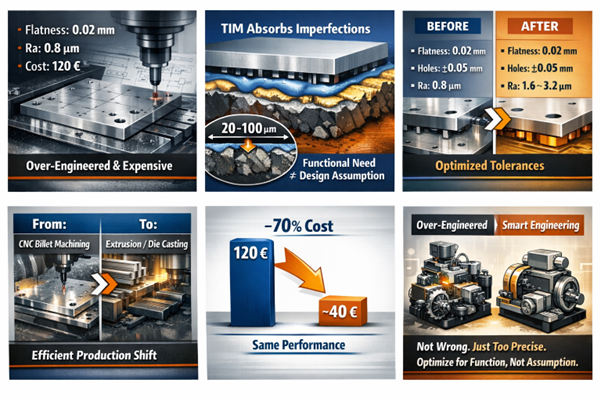
A very illustrative case where tolerance optimization dramatically reduces manufacturing cost is the aluminum heat‑sink baseplate used in power electronic assemblies. Designers often begin by specifying extremely tight geometric and surface tolerances—such as flatness of 0.02 mm across a large 300 × 200 mm plate, parallelism within 0.02 mm, bolt‑hole locations within ±0.05 mm, and surface roughness of Ra 0.8 µm—believing these values are required to ensure good thermal contact and reliable module mounting. However, these tolerances implicitly dictate that the part must be produced using a fully CNC‑machined approach starting from billet stock, involving multiple finishing passes, precision face milling, tight hole drilling, and repeated metrology checks. As a consequence, the part becomes far more expensive than necessary, with typical costs reaching around 120 € per unit.
A proper tolerance analysis reveals that these requirements are significantly stricter than what the functional performance of the assembly actually demands. Because thermal interface materials (TIMs)—such as silicone pads, greases, or phase‑change films—naturally accommodate unevenness of 20–100 µm, the baseplate does not require mirror‑level flatness or ultra‑low roughness. Relaxing the flatness to 0.05 mm and the roughness to Ra 1.6–3.2 µm still ensures excellent thermal contact and stable module positioning. Similarly, the bolt holes, which use clearance fits, can tolerate positional variations up to ±0.2 mm without affecting assembly quality. Even parallelism can be opened up to around 0.1 mm, since it has minimal influence on both thermal performance and structural integrity.
By adjusting the tolerances to match the true functional needs of the system, the part no longer requires machining from solid billet. Instead, it can be manufactured using much more efficient processes such as extrusion or high‑pressure die casting, which naturally produce most geometric features close to their final shape. Only a light finishing pass—often just a single face‑mill to meet the relaxed flatness requirement—is necessary, and the bolt holes can be drilled using simple fixtures rather than precision CNC equipment. Quality control also becomes simpler: instead of CMM inspection, basic gauges are sufficient.
The end result is a massive shift in manufacturing economics. With optimized tolerances, the part can be produced for 38–45 € instead of 120 €, representing approximately 70% cost reduction. This improvement is achieved without compromising thermal performance, mechanical stability, or assembly repeatability.
The key lesson was clear: the original tight tolerance wasn’t incorrect; it was simply more precise than the application required. Without early insight into the cost-performance trade-off, the team had unintentionally over-engineered the component.
The Shift Toward Design-Driven Cost Optimization
Modern digital engineering practices aim to bring cost considerations much earlier into the product development cycle.
Organizations now focus on how their design choices influence manufacturing costs and where they are over-engineering without realizing it. By integrating simulation, manufacturability insights, and cost estimation during design, engineers can evaluate multiple design alternatives quickly and understand their financial impact before committing to production.
In this approach, tolerances become a design variable with cost as an objective — just like stress, weight, or durability. This is where modern computational tools for tolerancing, accurate cost modelling, together with optimization techniques, play a crucial role.
CETOL 6σ is a 3D model-based tolerance analysis software that integrates directly into leading CAD platforms to help engineers predict, visualize, and resolve variation issues before they reach production. By identifying how part and assembly variation impacts product performance, CETOL enables faster decisions, reduced rework, and improved profitability.
Optimus, an automation and optimization tool by Noesis Solutions, enable teams to orchestrate simulations, cost models, and optimization algorithms into automated workflows.
Rather than manually testing one design at a time, Optimus workflows can automatically explore thousands of design combinations. They vary parameters such as geometry, material properties, and tolerances while checking functional performance and calculating cost. Optimus’ AI-enhanced Design of Experiments (DOE) and Response Surface Modeling techniques offer a clear view of trade-offs between functionality and affordability.
Optimus enables organizations to orchestrate simulations, cost models, and optimization algorithms into automated workflows. The outcome is smarter design choices, reduced development iterations, and significantly lower manufacturing costs.
In today’s competitive manufacturing landscape, smarter design-driven cost optimization is no longer optional, it’s essential.
Other posts
-
Simulation insights in a click: scaling expertise beyond specialists
Jul 17, 2026
-
Bringing SimApp Creation Inside the id8 Platform
Jun 04, 2026
-
Understanding nvision Training Times: Data, Hardware, and Engineering Trade-offs
Jun 04, 2026
-
What’s New in nvision 2026.1
May 19, 2026
-
How Optimus Powers Trustworthy Data for the Next Generation of Design
Feb 25, 2026
©2026 Noesis Solutions • Use of this website is subject to our legal disclaimer
Cookie policy • Cookie Settings • Privacy Notice • Design & Development by Zenjoy