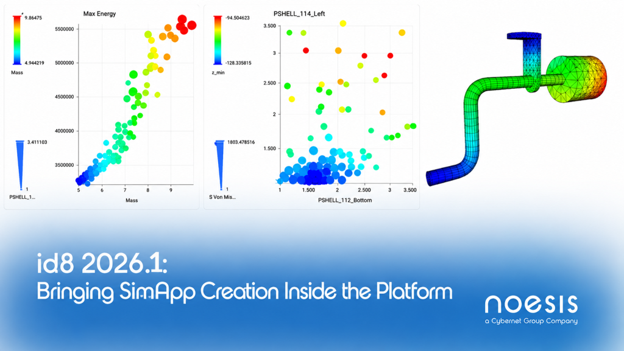
Bringing SimApp Creation Inside the id8 Platform
In most engineering organizations, the simulation workflow is only as accessible as the expert who built it. Senior engineers carry the knowledge of which parameters matter, which configurations are valid, and which constraints cannot be compromised. When those engineers are busy, the rest of the team waits. When they move on, the knowledge moves with them.
Teams have faster solvers, more computing power, and broader toolchains than ever before. The constraint, in most cases, is in how that capability reaches the people who need it.
In this blog, we look at what id8 2026.1 introduces, how the SimApp creation flow works in practice, and what it means for engineering teams trying to scale simulation access across distributed environments.
With SimApps Now Native To id8
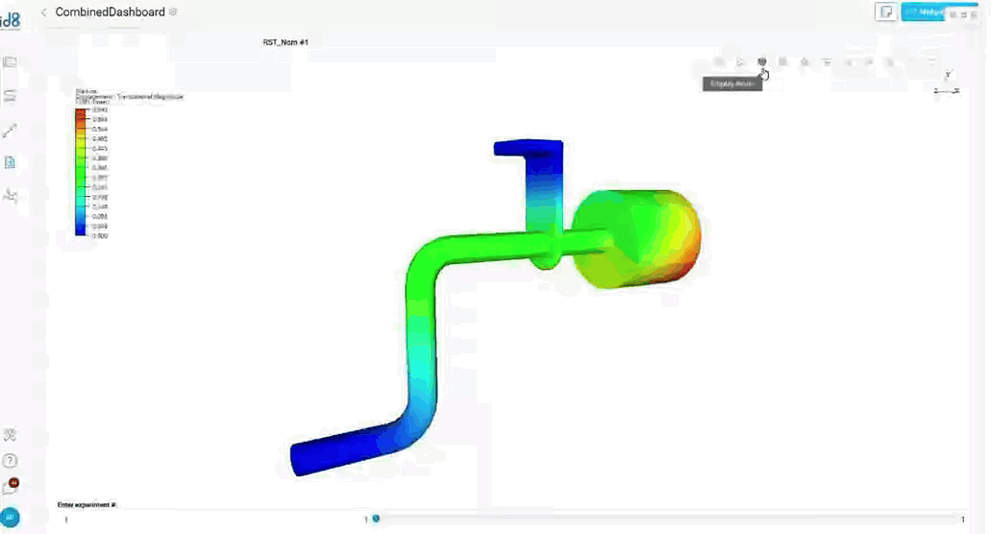
SimApps were designed to address this directly. As one-click applications that package complex simulation workflows into controlled, repeatable interfaces, they allow any engineer on the team to run a validated process without needing deep CAE expertise. The underlying logic, the solver configuration, the parameter boundaries, all of it is encoded by the expert who built the workflow. What the rest of the team sees is a clean, focused interface with exactly what they need to run the process correctly.
The value of that separation is significant. It means simulation capacity is no longer gated by the availability of specialists. Product engineers can run analyses independently. Iteration cycles tighten. And the expert's time is freed for the work that actually requires deep expertise, rather than being consumed by requests that a well-designed SimApp could handle.
Until now, however, creating a SimApp required a development step that lived outside of id8. Building the interface, configuring the workflow exposure, and deploying the application involved effort that sat outside the platform and added friction to the process.
With the release of id8 2026.1, that step is gone. SimApps can now be created directly inside id8 using intuitive graphical components, with no coding required. The entire process, from workflow selection to deployment, takes place within a single environment.
How The Creation Flow Works
The creation flow begins with an existing Optimus workflow, a structured, validated simulation process built by a lead engineer. This workflow represents the expertise that needs to be packaged. It contains the logic, the solver connections, the variable definitions, and the constraints that make the simulation trustworthy. In id8, this workflow becomes the foundation on which the SimApp is built.
Inside the id8 platform, the expert opens the SimApp creation dashboard and begins configuring the user interface. This is where the engineering boundaries are defined. The expert decides which input parameters to expose to users, sets nominal values and adjustment ranges, and determines what cannot be modified. Every decision made at this stage shapes the experience of the engineer who will eventually run the application, and more importantly, it shapes the integrity of the results they produce.
Once the interface is configured, clicking Generate prompts id8 to scan the predefined workflow and surface a set of configuration options for the expert to review. This automated scanning step reduces the manual effort involved in connecting the interface to the underlying workflow logic. The expert reviews, fine-tunes where necessary, and publishes the SimApp to the team.
From that point, any engineer with access to the relevant id8 project can open the SimApp, adjust the exposed parameters within the defined boundaries, select an optimization algorithm if applicable, and run the simulation. The process is repeatable, controlled, and independent of the expert who built it.

Consistency Across Distributed Teams
For teams operating across different locations, the benefit of SimApp-based workflows extends well beyond individual productivity. One of the persistent challenges in distributed engineering organizations is result comparability. When different teams run nominally the same simulation through different setups, minor variations in solver configuration, parameter defaults, or workflow logic accumulate into results that cannot be cleanly compared. The data looks similar, but the confidence required to make decisions from it is undermined.
When every team member accesses the same SimApp library through id8, they run identical workflow logic with identical solver configurations. The input boundaries are the same. The output structure is the same. Results are directly comparable across locations, disciplines, and time, regardless of who ran the simulation or when.
This matters for engineering directors in a specific way. The ability to trust cross-team data without requiring manual verification of every run is not a convenience. It is a structural shift in how simulation results can be used to support decisions. When the process behind the data is standardized and controlled, the data itself becomes a reliable input at every stage of the product development cycle, from concept through validation.
Sharing and permissions are managed at the project level inside id8. Engineering leaders can distribute access to specific SimApps within a project, define role-based permissions, and ensure that the right people are working with the right data. The flexibility to scale access across the organization does not come at the cost of oversight.
What This Means For Engineering Organizations
The measure of a mature engineering organization is not how capable its best engineer is. It is how effectively that capability reaches the rest of the team.
For many organizations, the gap between those two things is larger than it appears. The expertise exists, the simulation tools are in place, and the workflows have been validated. What is missing is the infrastructure to make that expertise accessible at scale, consistently, and without creating a dependency on the individuals who hold it.
id8 2026.1 addresses that gap directly. Expert knowledge is captured in validated Optimus workflows, structured into controlled SimApps, and deployed through a platform the entire organization can use. The result is not just faster simulation turnaround. It is a more resilient engineering process, one where the quality and consistency of simulation outputs no longer depends on the availability of a handful of specialists.
The data produced through this process is consistent and robust enough to support decisions across every stage of product development, from early design exploration through final validation. And as more SimApps are built and deployed across the organization, the collective simulation capability of the team compounds, independent of headcount growth.
For engineering organizations running simulations across distributed environments and looking to extract more value from existing expertise and tooling, id8 2026.1 is worth a closer look.

Other posts
-
Simulation insights in a click: scaling expertise beyond specialists
Jul 17, 2026
-
Understanding nvision Training Times: Data, Hardware, and Engineering Trade-offs
Jun 04, 2026
-
What’s New in nvision 2026.1
May 19, 2026
-
Why Cost Optimization Should Start at the Design Stage
Apr 23, 2026
-
How Optimus Powers Trustworthy Data for the Next Generation of Design
Feb 25, 2026
©2026 Noesis Solutions • Use of this website is subject to our legal disclaimer
Cookie policy • Cookie Settings • Privacy Notice • Design & Development by Zenjoy